

97.9%
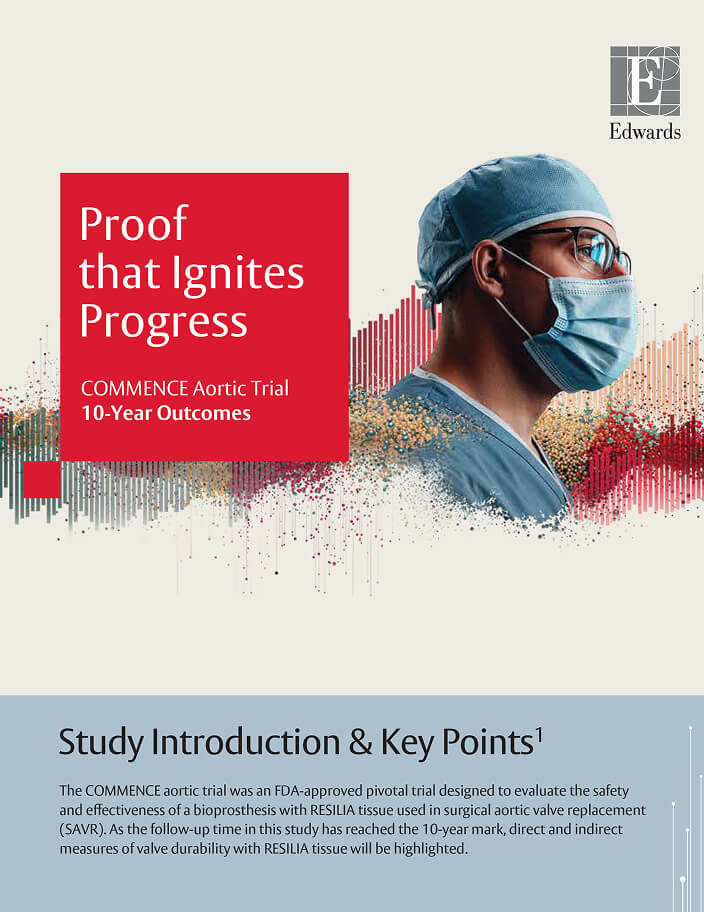
Proof that Ignites Progress

Together we are building a comprehensive body of evidence to drive innovation and clinical excellence
COMMENCE Aortic Trial: Long-Term 10-Year Durability Outcomes
Results at 10 years
The COMMENCE aortic trial provides a decade of follow-up in a large, prospective, non-randomized, multicenter, single-arm, IDE trial exploring the safety and effectiveness of surgical aortic valve replacement (SAVR) with a bioprosthesis utilizing RESILIA tissue. Across US and European clinical sites, 192 patients completed the 10-year visits.1,2
97.8%
Freedom from reoperation due to SVD
94.3%
Freedom from valve-related mortality
For more details, download the clinical infographic.
Explore the clinical data
With excellent outcomes, a favorable safety profile, and stable hemodynamics through 10 years, the COMMENCE aortic trial demonstrates durable results for bioprostheses with RESILIA tissue.
The 10-year data from the COMMENCE trial represent the longest follow-up after SAVR with RESILIA tissue

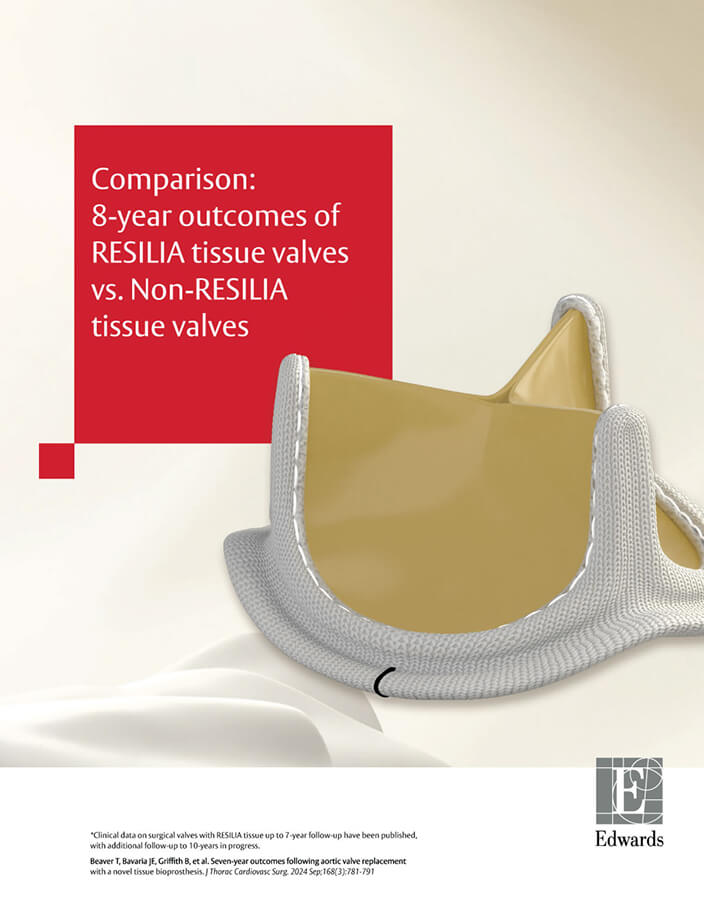
Eight-Year Outcomes of RESILIA Tissue Valves vs Non-RESILIA Tissue Valves
Results at 8 years
Long-term outcomes compared between RESILIA tissue (n=689; n=239 reconsented) and non-RESILIA tissue (n=258) valves using propensity-matched data from 2 prospective trials in SAVR patients. RESILIA tissue valves significantly outperformed contemporary tissue bioprostheses in SAVR patients.4
99.2%
Freedom from reoperation due to SVD vs 93.9%*
99.3%
Freedom from SVD vs 90.5%*
97.0%
Freedom from all-cause reoperation vs 90.5%*
For more details, download the clinical infographic.
Explore the clinical data
Clinically stable hemodynamics were observed in the RESILIA tissue valve cohort, supporting excellent valve durability through 8 years.
* Comparator arms: RESILIA tissue valves vs non-RESILIA tissue valves.
Watch Dr Tsuyoshi Kaneko, Chief of Cardiac Surgery at Washington University in St. Louis, present the 8-year follow-up data from this study
RESILIA tissue valves may maximize life expectancy while balancing valve durability over non-RESILIA tissue valves
COMMENCE Aortic Trial: Bicuspid Aortic Valve Subanalysis
Results at 7 years
A subanalysis of the COMMENCE aortic trial compared outcomes of 214 patients with bicuspid aortic valves (BAV) vs 458 patients with tricuspid aortic valves (TAV).5
For more details, download the clinical infographic.
Explore the clinical data
The BAV group exhibited similar clinically stable mean gradients. The 7-year BAV results in this trial serve as a benchmark for future SAVR BAV patient outcomes.
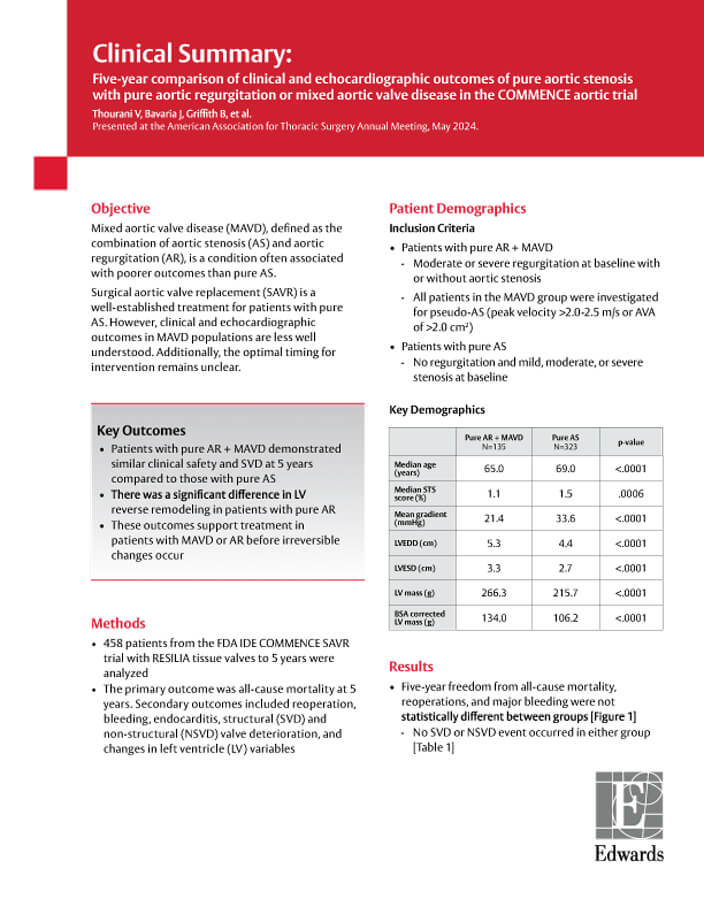
COMMENCE Aortic Trial: Five-Year AR vs AS Outcomes
Results at 5 years
A 5-year comparison of clinical and echocardiographic outcomes of pure aortic stenosis (AS) with pure aortic regurgitation (AR) or mixed aortic valve disease (MAVD) in the COMMENCE aortic trial.6 Five-year outcomes of the pure AR + MAVD arm vs pure AS arm (from the COMMENCE aortic trial) demonstrated:
88.3%
Freedom from all-cause mortality vs 87.4% (P=.67) in the pure AS arm
100%
Freedom from SVD vs 100% in the pure AS arm
100%
Freedom from NSVD vs 100% in the pure AS arm
For more details, download the clinical summary.
Explore the clinical data
Patients with moderate to severe AR with or without AS demonstrated similar clinical safety outcomes over 5 years compared to patients with pure AS. These outcomes may support the benefit of treatment in patients with MAVD or AR before irreversible changes occur.
References
- Svensson L, Blackstone E, Bavaria JE, et al. Long-term outcomes following aortic valve replacement with a novel tissue bioprosthesis: 10-year results from the COMMENCE trial. Presented at the American Association for Thoracic Surgery, May 2026.
- Beaver T, Bavaria JE, Griffith B, et al. Seven-year outcomes following aortic valve replacement with a novel tissue bioprosthesis. J Thorac Cardiovasc Surg. 2024;168(3):781-791. doi:10.1016/j.jtcvs.2023.09.047
- Akins CW, Miller DC, Turina MI, et al. Guidelines for reporting mortality and morbidity after cardiac valve interventions. Ann Thorac Surg. 2008;85(4):1490-1495. doi:10.1016/j.athoracsur.2007.12.082
- Kaneko T, Bavaria JE, Thourani VH, et al. Propensity-adjusted 8-year outcomes following bioprosthetic aortic valve replacement: The influence of novel anticalcification technology. JTCVS Open. 2025;29:101557. doi:10.1016/j.xjon.2025.101557
- Salna M, Bavaria JE, Heimansohn D, et al. Seven-Year Results for RESILIA Tissue in Bicuspid Aortic Valve Replacement Patients: Age and Valve Size Considerations. Interdiscip Cardiovasc Thorac Surg. 2025;40(8):ivaf176. doi:10.1093/icvts/ivaf176
- Thourani, VH, Puskas JD, Griffith B, et al. Five-year Comparison of Clinical and Echocardiographic Outcomes of Pure Aortic Stenosis with Pure Aortic Regurgitation or Mixed Aortic Valve Disease in the COMMENCE Trial. JTCVS Open. Sept (2024); https://doi.org/10.1016/j.xjon.2024.08.020
Important Safety Information
Important Safety Information
RESILIA Tissue Devices
Indications: INSPIRIS RESILIA Aortic Valve - For use in replacement of native or prosthetic aortic heart valves. KONECT RESILIA Aortic Valved Conduit - For use in replacement of native or prosthetic aortic heart valves and the associated repair or replacement of a damaged or diseased ascending aorta. MITRIS RESILIA Mitral Valve - For use in replacement of native or prosthetic mitral heart valves.
Contraindications: There are no known contraindications with the use of these RESILIA tissue heart valve devices.
Complications and Side Effects: INSPIRIS RESILIA Aortic Valve: Thromboembolism, valve thrombosis, hemorrhage, hemolysis, regurgitation, endocarditis, structural valve deterioration, nonstructural dysfunction, stenosis, arrhythmia, transient ischemic attack/stroke, congestive heart failure, myocardial infarction, any of which could lead to reoperation, explantation, permanent disability, and death. Additional adverse events potentially associated with the use of polyester vascular grafts in the KONECT RESILIA AVC include hemorrhage, thrombosis, graft infection, embolism, aneurysm, pseudoaneurysm, seroma, occlusion (anastomotic intimal hyperplasia), immunological reaction to collagen (shown to be a weak immunogen; infrequent, mild, localized and self-limiting), intimal peel formation, and conduit dilatation. MITRIS RESILIA Mitral Valve - Thromboembolism, valve thrombosis, hemorrhage, hemolysis, regurgitation, endocarditis, structural valve deterioration, nonstructural dysfunction, stenosis, arrhythmia, transient ischemic attack/stroke, congestive heart failure, myocardial infarction, ventricular perforation by stent posts, any of which could lead to reoperation, explantation, permanent disability, and death.
Warnings: INSPIRIS RESILIA Aortic Valve - DO NOT ADJUST THE VALVE DIAMETER BY EXPANDING THE BAND PRIOR TO OR DURING IMPLANTATION OF THE SURGICAL VALVE. The expandable band is not designed to allow for compression or expansion during implantation of the surgical valve. This will cause damage to the valve and may result in aortic incompetence. DO NOT PERFORM STAND-ALONE BALLOON AORTIC VALVULOPLASTY PROCEDURES ON THIS VALVE FOR THE SIZES 19 - 25 mm as this may expand the valve causing aortic incompetence, coronary embolism or annular rupture. Valve-in-valve sizing in the INSPIRIS valve has only been tested with specific Edwards transcatheter heart valves. Use of other transcatheter valves may result in embolization of transcatheter devices anchored within or result in annular rupture.
CAUTION: US law restricts these devices to sale by or on the order of a physician. See instructions for use for full prescribing information.